
There's no shortage of options for building a website today. So why, with newer tech available, would anyone still choose WordPress? If you're familiar with the languages and frameworks behind more complex web applications, why settle for something so... basic, as many engineers would call it?
Before getting into that, it's worth looking at the market. According to w3techs, a significant majority of the web runs on some kind of CMS — almost 70% of all sites. Of that 70%, one framework stands out: WordPress, with nearly 60% of the CMS market.
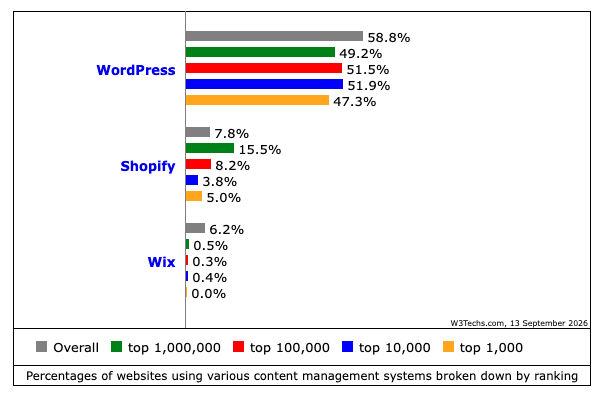
Though I don't believe popularity alone makes something the best choice. So what does? Ease of use, extensibility, the programming language?
Those all matter, but the real question is whether a framework fits the job without being over-engineered — meaning the complexity of building and maintaining it outweighs what it actually delivers.
Making this technical decision, usually leads me to two extremes: frameworks that allow full control, and so-called "no-code" solutions at the opposite end.
No-code platforms solve a specific problem: they give non-developers — often small business owners — a way to launch a site and update it themselves. You've likely heard of the major platforms: Shopify, Wix, Squarespace, which are all marketed as an easy way to get a business online.
They require no knowledge of code, hosting, versioning, or security. They're a legitimate solution for anyone who can't afford custom development, doesn't need it, or would rather not deal with a developer at all.
But they come with two major tradeoffs: vendor lock-in, and no ability to touch the code, especially on the backend.
WordPress sits in between these extremes. With a simple setup and the right page-builder plugin, you get that same ease of use without giving up the ability to customize the site in depth.
That said, WordPress isn't without its own drawbacks, and it would be misleading for me to tell you otherwise. A full list could run longer, but here's the major benefits and drawbacks as I see them:
Pros
- Relatively easy to set up
- An extensive plugin ecosystem
- Highly extensible
- Built-in user management, API, and block editor
- Popular enough that hiring developers is easy
Cons
- Some plugins are bloated and can slow your site down
- A frequent target for hackers and spam bots
- Security risks tied to well-known patterns and vulnerabilities
- Mixed reviews on the built-in block editor/page builder
- Customization can get expensive
When is WordPress not the right choice?
There are a few cases where it isn't the right tool for the job:
- sites that don't need frequent updates
- complex web applications intended to scale
For simple small business websites that you don't intend to update often, a static website might be a good choice. You can get a fast-loading site that doesn't cost you anything in terms of hosting or management this way.
For more complex web apps, there's a myriad of options. Next.js is a popular choice that provides structure, and several optimizations.
Conclusion
WordPress is still well-suited for marketing websites — a category most small business sites fall into — and it can handle more advanced needs like forums or e-commerce. But beyond those common use cases, I'd reach for a more modern stack.
There is always competitive interest in creating alternatives to WordPress. So the landscape may change in 2027. But given the depth of the WordPress ecosystem and the large developer network, it will be hard to topple as the leader in the space.
That being said, it's worth keeping an eye on alternatives — such as the Instatic CMS. With a modernized tech stack and privacy respecting analytics built-in, it's certainly worth consideration.
In any case, understanding the tools available, will ensure you pick the best one for the work at hand.